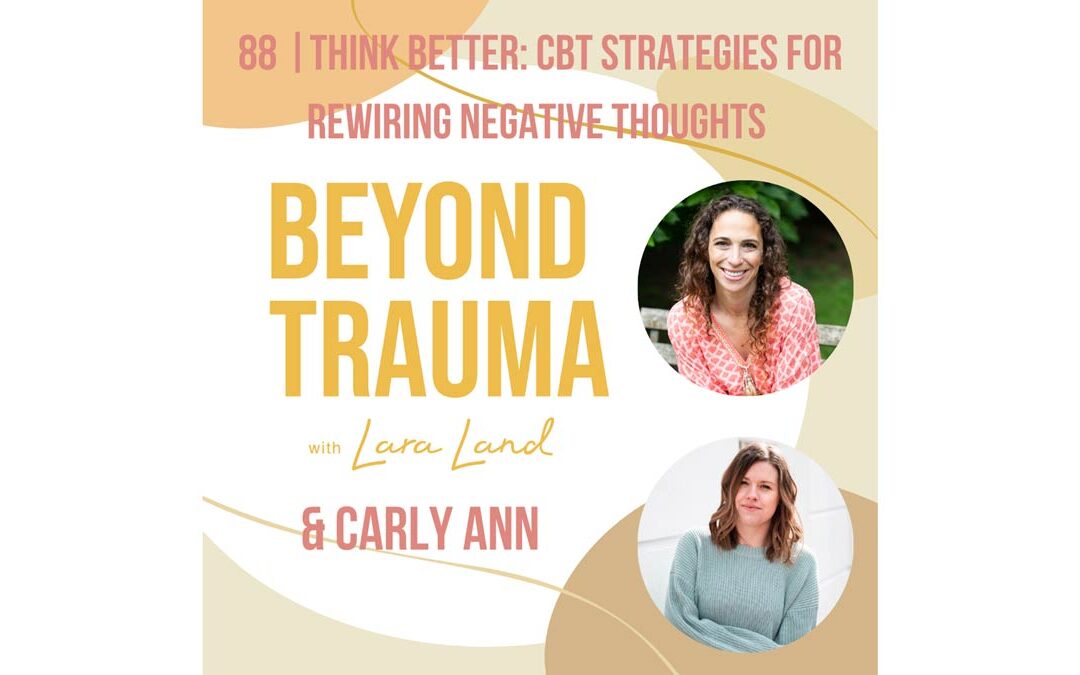
In this week’s episode of Beyond Trauma, I had the pleasure of sitting down with psychotherapist Carly Ann to explore the powerful principles of Cognitive Behavioral Therapy (CBT)—and how we can all use them to break free from the mental loops that keep us anxious, overwhelmed, and stuck.
Whether you’re navigating anxiety, low self-worth, perfectionism, or the emotional fallout of trauma, CBT offers real, research-backed tools for reclaiming your thoughts and calming your nervous system.
“It’s not about asking: Can I stop having these thoughts? It’s about asking: Can I stop feeding them?” — Carly Ann
Here’s a breakdown of what we covered, plus additional insights and resources you can use to deepen your healing.
What is CBT—and Why Does It Work?
CBT is a short-term, evidence-based approach to mental health that focuses on identifying and challenging negative automatic thoughts (NATs) and replacing them with more balanced, helpful thinking.
Research consistently shows CBT’s effectiveness in treating anxiety disorders, depression, PTSD, and even chronic pain and insomnia. The American Psychological Association recognizes CBT as one of the most effective tools for managing trauma-related symptoms.
Common Cognitive Distortions: Are These Running Your Life?
Carly and I explored the mental patterns that often fuel anxiety and low self-worth. These include:
- Catastrophizing – assuming the worst will happen
- Black-and-white thinking – seeing everything as all good or all bad
- Should/Must statements – rigid rules that often lead to guilt and frustration
- Mind reading – assuming you know what others think of you
You can see a full list of distortions here from Therapist Aid, and use them to start identifying your personal thought patterns.
How to Deal with Anxiety: Don’t Feed the Thoughts
One of the most helpful reframes Carly shared was this: You don’t have to stop your thoughts—but you can stop giving them power.
This aligns with the CBT skill of cognitive defusion, a technique also used in Acceptance and Commitment Therapy (ACT), where we learn to observe thoughts without becoming entangled in them.
When anxious thoughts arise, try asking:
- Is this thought helpful?
- Is it true—and can I prove that?
- What would I tell a friend who had this thought?
The Thought-Feeling-Behavior Loop
In CBT, we recognize that how we think influences how we feel, and how we feel influences what we do. This is the cognitive triangle—and understanding it can help you make powerful shifts in your behavior.
For example:
- Thought: I’m going to fail at this presentation.
- Feeling: Anxious, inadequate.
- Behavior: Procrastinate or avoid preparing.
By challenging the original thought, you can interrupt the whole cycle and act from a more grounded place. Tools like a CBT thought record can be a great place to start.
“Eat That Frog” and Morning Mindset
Carly and I also talked about the importance of starting your day with clarity and intention. We both love Eat That Frog by Brian Tracy—a simple yet powerful guide for overcoming procrastination by tackling your hardest task first thing in the morning.
Research suggests that the first 30 minutes of your day significantly influence your mood and productivity. Try:
- Avoiding your phone
- Doing a short journaling or meditation practice
- Planning your top 3 priorities
Even small shifts can reduce anxiety and create a stronger mental foundation.
The Role of Affirmations—And When They Backfire
We also touched on positive affirmations—and the important distinction between toxic positivity and balanced thinking.
While saying “I love myself” might help some people, it can feel fake or even harmful if it’s too far from what you believe. Instead, CBT encourages neutral or balanced thoughts, such as:
- “I’m doing the best I can right now.”
- “It’s okay to feel anxious—this doesn’t define me.”
For more on this, check out this article on how affirmations can sometimes backfire—and what to do instead.
Are Your Needs Reasonable? And What to Do When They’re Not Met
Carly also shared how CBT can help us evaluate the expectations we place on others. We often assume people “should” know how to meet our needs—but haven’t communicated them clearly, or don’t know how to process the pain of those needs being unmet.
CBT invites us to:
- Ask: Is my request clear and realistic?
- Consider: Is the disappointment about this person—or about something deeper I need to grieve?
Dr. Marshall Rosenberg’s Nonviolent Communication method can help here—focusing on needs rather than judgments or demands.
Support for Clinicians
If you’re a therapist, Carly shares insightful guidelines for using CBT with clients experiencing depression or low motivation. She emphasizes pacing, collaborative exploration, and validating the emotional reality while gently challenging unhelpful thoughts.
Final Thoughts: Think Better, Feel Better
You’re not broken for having negative thoughts. They’re part of being human. But with awareness and the right tools, you can stop letting them run the show.
If you want to go deeper, listen to the full episode with Carly Ann here. And if CBT has helped you, or you have questions about starting, I’d love to hear from you in the comments or on Instagram @laralandyoga.