by Lara Land | Mar 19, 2023 | COACHING, COMMUNITY, LAND BLOG, LARA LAND, Self Improvement, SELF-IMPROVEMENT
The war on trans people has been intensifying in recent years, with a wave of anti-trans legislation sweeping across the United States. Many states are passing laws that restrict access to gender-affirming healthcare, including hormone therapy and gender-confirming surgery. These laws can have devastating consequences for trans individuals, who may be unable to access the care they need to live authentically, comfortably, and trauma free.
Gender-affirming therapy, also known as gender-confirming therapy, is a crucial component of healthcare for many transgender individuals. This therapy can take many is designed to help trans individuals align their bodies and identities in a way that feels authentic and comfortable. However, not all trans individuals have access to gender-affirming therapy, and the consequences of this can be severe.
As Dr. Gabor Mate’ so eloquently notes in his best-seller, The Myth of Normal: Trauma, Illness & Healing in a Toxic Culture, humans have an innate need to both live true to their most authentic self and to be accepted for who they are. Failure to experience either authenticity or acceptance results in a traumatic split of the internal system. Maté believes that cultivating authenticity and acceptance can help individuals heal from trauma, overcome addiction, and improve their overall well-being.
One of the most significant consequences of not receiving gender-affirming therapy is this impact on mental health. Trans individuals who are unable to access the care they need may experience depression, anxiety, and other mental health issues. This is due to the distress caused by a misalignment between their gender identity and their physical body which doesn’t allow them full authenticity. It is also due to societal stigma and discrimination. Suicide rates among transgender individuals are alarmingly high. According to the American Foundation for Suicide Prevention, suicide attempts are 14 times higher among transgender individuals compared to the general population. The transgender community also experiences a disproportionately high murder rate compared to cisgender individuals and higher rates of physical violence.
Despite these horrifying statistics, the transgender community continues to be filled with bright, courageous, hopeful individuals daring to live their most authentic lives, heal their trauma, and show us all what it could mean to exist beyond binaries. It is via these relationships and teachings that I have grown to envision and understand what a freer nongendered world could look like for all of us. Jacoby Ballard, author, social justice educator and yoga teacher, has been one of my core teachers of the trans experience and the positive impact queer and trans liberation has on all of us.
Jacoby is deeply forgiving, kind, and a “call in” person who is helping other to learn to forgive through his dharma teachings and way of being. In our conversation on the latest episode of the Beyond Trauma podcast we dive into practices of forgiveness, easing anger, and accepting grief. It’s a powerful conversation and one which taught me what it means to be present, and willing to dare to assume the best in others. I hope you’ll take a listen HERE.
by Lara Land | Mar 13, 2023 | COACHING, COMMUNITY, LAND BLOG, LARA LAND, Self Improvement, SELF-IMPROVEMENT
While I started out investigating trauma from the same viewpoint as many of you, spurned by a single event, attack, or natural disaster, my definition of the kinds of events that could cause trauma has grown steadily year by year. I’ve landed most recently on the potential and likelihood of society as it is, filled with scarcity, conflict, fear, and competition being absolutely enough to leave all of us impacted by trauma. This unnatural and toxic load we all carry in today’s society is making us sick and that must be addressed. Simply asking folks to slow down, nap, rest, etc without the support systems to do so is not only impossible but potentially harmful as the correct social safety nets are not in place to make sure that doesn’t cause more harm.
Living a life in a constant state of stress however low is extremely taxing on our systems. In fact, low levels of ongoing stress hormones may be some of the hardest to identify as being present and therefore not be addressed as causing ongoing health problems. Think of a low but constant buzz and the headache and exhaustion that can cause and you will get a sense of what I mean. Or consider an undetected slow leak that drips and drips and drips.
We must also think about the holding in of emotions so regular in our society. Studies show that repressing and suppressing emotions makes us sicker and can cause disease. And yet society does not provide us with acceptable ways of releasing the stress it imposes. My European husband is red hot embarrassed when I scream which is deemed totally inappropriate in his culture, and it’s not that much more okay in the US. We all need to scream, pound a pillow or throw something now and again. The latest trends of Ax throwing and break everything Rage Rooms as entertainment are proof we are desperate for release. Drumming, dancing, trancing, and yes yelling can help get it out!
So, as we look to lessen the allopathic load we can consider multiple pathways including trauma-focused therapy, such as cognitive-behavioral therapy or eye movement desensitization and reprocessing (EMDR), which can help individuals process and cope with traumatic experiences. Mind-body practices, such as yoga, yoga retreats, meditation, and tai chi, can also be helpful in reducing stress and promoting healing. And…as we keep all these therapies in mind we must also work to make breaks, vacation days, and other destressing opportunities more regular and accepted in our social environment or we will never be able to keep up with the heavy load of living in modern society.
If you are interested in learning simple and highly impactful ways of reducing stress and regulating your nervous system for yourself and others, please join me for a yoga retreat at Kripalu Center for Health June 30th-July 2nd where this will be the main area of focus.
by Lara Land | Nov 28, 2022 | BOOKS, COACHING, COMMUNITY, LAND BLOG, LARA LAND, Self Improvement, SELF-IMPROVEMENT
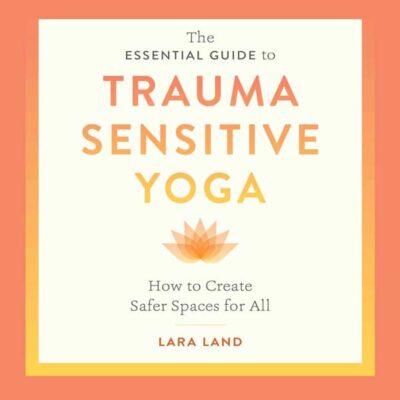
Many of you have likely heard about trauma sensitive yoga by now. You may even have read books on it such as The Body Keeps the Score, Waking the Tiger, and Why Zebras Don’t Get Ulcers. Perhaps you’ve pre-ordered my book, The Essential Guide to Trauma Sensitive Yoga. I hope you have. Yoga for trauma studies are getting more and more popular and more information is getting out there during this time when more folks than ever are identifying as having survived trauma or traumatic stress.
This is a change from the earliest studies we had which were largely from veterans. Most of the earliest trauma sensitive yoga programs were for veterans diagnosed with PTSD. Those programs proved again and again the power of trauma sensitive yoga to reverse the impacts of trauma, restore the nervous system and give folks a chance to change their response to traumatic stress.
No one knows that better than the next guest of the Beyond Trauma Podcast. Pamela Stokes Eggleston has been sharing yoga years with Veterans suffering from PTSD or traumatic stress and their families. She was inspired to focus on this demographic after her own husband returned injured from service and she needed to learn how to live with that. The vicarious trauma she experienced from living with someone with PTSD also had to be addressed. Pam was able to address it with yoga and yoga related practices and one thing she was especially able to treat is sleep. This is deeply important because sleep is always disturbed with trauma and sleep disturbance makes the impacts of trauma more severe.
Take a listen to Pam on the Beyond Trauma Podcast to learn more about yoga for veterans and how she is improving their sleep and hers with some special practices.
If this resonates with you, you may want to consider a trauma sensitive yoga training. I’m offering both an online trauma sensitive yoga training (this weekend) and in many person trainings in the coming year including the weekend of June 30th at Kripalu in Massachusetts (which will be listed next week) and the weekend of August 18th at Miami Life Center, in Florida. More to be listed soon!
by Lara Land | Oct 17, 2022 | LAND BLOG, LARA LAND, Self Improvement
How a new kind of affirmation made a difference for D’Angela.
*Trigger Warning
D’Angela Albery was born into the cycle of trauma. As a child she witnessed and was the victim of physical, emotional, and sexual abuse that began while she was in the womb. Never experiencing anything else, abuse was normal to her and she didn’t know that there could be another way. Yet, despite a campaign to make her feel worthless and trapped something inside of her told her to escape.
The story of D’Angela’s flee from her childhood home and subsequent detachment from her abusive partner is detailed in the latest episode of The Beyond Trauma Podcast. She shares the people and techniques which allowed her to understand her worth and break the cycle of trauma for her three small children.
One of those is using “What If” affirmations. When as a trauma survivor, speaking an affirmation was too much for D’Angela to believe in, she added the words “what if” to the beginning and she could start to imagine a different life.
Try it now:
What if I am smart?
What if I am worthy?
What if I am enough?
D’Angela is not just a trauma survivor. She is now a speaker, a coach, a trauma-sensitive yoga teacher and the program director at Three and a Half Acres Yoga. She is a true inspiration to all trauma survivors. Listen to her full story on iTunes or Spotify and get trained like her to be a trauma-sensitive yoga teacher this December at Three and a Half Acres trauma-sensitive yoga teacher training!
Highlight- trauma, trauma survivor, trauma-sensitive yoga, trauma-sensitive yoga teacher training, affirmations
by Lara Land | Oct 3, 2022 | LAND BLOG, LARA LAND, Self Improvement
There’s been a lot of controversy in recent years over the role of the teacher in yoga and in other wellness modalities, and rightfully so. Too often we give ourselves over to a guru, eager to release ourselves from having to do the hard work of designing and committing to our own path to healing. With all our many responsibilities in modern life, it can feel great to surrender.
We have seen, however, the dangers that come with that kind of surrender, especially for trauma survivors, who need perhaps more than any of us to establish their own path to healing and be supported and affirmed in it. What is their route then? Can they or any of us take a teacher?
The truth is that teachers, guides, counselors, and maybe even gurus play strong roles along our path. Sometimes, as in the case with, Lama Rod Owens, my latest guest on the Beyond Trauma Podcast, just being in their presence is enough to make us feel calm. Other times, it’s their knowledge, charisma, or life experience that draws us to them. There are so many things that others have to teach us.
It’s the teachings, Lama Rod reminds us, that we should take refuge in and surrender to, not the fallible human!
The teacher is there to translate the teachings for us and, if they are truly in practice and living them, to show us that it is possible. They do not make it possible to skip the work of dealing with our own traumas and reactions as trauma survivors or however we identify as students and ever-growing humans.
That there is really hard work to do to liberate ourselves from conditioning and that it can be done are some of the core teachings I received from being in this conversation and some of the messages I also convey to my students.
In my life coaching, with folks, trauma survivors or not, for instance, I am always careful to be clear about what I can and can not do for my clients:
- I can ask questions that may point you towards inner knowledge and openings.
- I can not tell you what to do or make you do the things you need to do to make your life fuller.
- I can share my experiences, make suggestions, and reveal patterns of human nature.
- I can’t promise what works for me will always work for you.
I can’t promise anything really, because we don’t fit a single mode, but I have seen that in small groups, the sharing of common blocks and patterns can really allow realizations to occur for each member of the group. That’s why I love group coaching with small, confidential groups. We learn from each other, not just from me, and so many similarities are present.
My next group life coaching series starts Wednesday, October 12th, and runs online for six weeks from 7-8:15 pm. I’d love for you to be a part of it!
And to catch all the wise teachings I got to experience with Lama Rod, make sure to take a listen to the latest Beyond Trauma Podcast now available on iTunes, Spotify, or anywhere you listen to podcasts!