AUTHOR OF MY BLISS BOOK & THE ESSENTIAL GUIDE TO TRAUMA SENSITIVE YOGA

Lara Land New Logo 2022

AUTHOR OF MY BLISS BOOK &
THE ESSENTIAL GUIDE TO TRAUMA SENSITIVE YOGA

Lara Land New Logo 2022
Intimacy, Healing & Partnership: A Conversation with Wendy Maltz

Intimacy, Healing & Partnership: A Conversation with Wendy Maltz

In this heartfelt episode of Beyond Trauma, Lara Land welcomes renowned sex therapist Wendy Maltz to explore how couples can reconnect and reclaim their bond—especially after stress, trauma, or emotional disconnection.

Whether you’re partnered or on a journey of personal healing, this conversation offers deeply compassionate guidance for cultivating conscious and connected relationships—with yourself or with someone you love.

The Quiet Ways Stress Erodes Intimacy

Stress doesn’t always show up as shouting or slammed doors. Often, it seeps in through everyday disconnection: the hurried goodbye, the missed check-in, the constant mental multitasking.

As Wendy explains, trauma survivors in particular may develop coping patterns that include emotional withdrawal, hypervigilance, or avoidance of touch and vulnerability. Over time, this can dampen intimacy—even when love remains.

“Stress creates distance. We don’t always see it, but we feel it—in our hearts, in our bodies, in our beds.” – Wendy Maltz

Creating Safety to Talk About Sex

Many couples avoid talking about sex because they don’t know how to do it without triggering discomfort or shame. Yet open, respectful dialogue is one of the most healing tools we have.

Wendy shares trauma-informed practices for initiating these conversations gently and building communication skills that encourage:

  • Curiosity instead of judgment
  • Consent and clarity instead of pressure
  • Attunement to both words and body language

These practices echo what researchers at The Gottman Institute emphasize: emotional safety is the bedrock of long-term sexual connection.

What’s Your Shared Sex Mission?

One standout tool Wendy introduces is the Sex Mission Statement—a collaborative process where partners explore what they want their sexual relationship to feel like. For example:

  • Is it playful? Sacred? Spontaneous? Healing?
  • Are there goals around exploration or rebuilding trust?
  • What boundaries and values need to be honored?

This exercise helps shift the focus from “how often” to “how meaningful”—and can be especially powerful for couples navigating the aftermath of trauma or medical challenges.

Foreplay Starts Long Before the Bedroom

Forget scented candles and perfectly timed playlists. According to Wendy, true foreplay begins with the energy we bring into the relationship throughout the day.

Do you greet your partner with warmth?
Do you show appreciation for small things?
Do you make room for tenderness even on busy days?

These everyday gestures act as emotional bids, a core concept from John Gottman’s research. Responding positively to these small connection attempts builds emotional safety in your relationship and can significantly boost intimacy and trust.

Balancing Closeness and Autonomy

Long-term partnerships thrive on two core needs: intimacy and independence. When one overtakes the other, the relationship can start to feel either suffocating or distant.

Wendy invites us to explore this balance. Healing happens not by becoming one entity, but by learning how to show up fully as ourselves—while choosing connection again and again.

Creativity as a Healing Force

Trauma can make the body and mind feel frozen. Wendy reminds us that playfulness and creativity—whether in sexual exploration, art, or movement—can reignite a sense of agency and aliveness.

Reframing sex as a space for empowered choice rather than performance or obligation is one of the most powerful shifts a trauma survivor can make. It replaces shame with curiosity, and fear with freedom.

Key Takeaways from Wendy Maltz

If you’re feeling disconnected—from your partner, your body, or your desires—this conversation is a beautiful place to start. Here are a few powerful practices to try:

  • Identify daily stressors that may be impacting intimacy
  • Create a shared sex mission statement with your partner
  • Start foreplay in the morning—with kindness, eye contact, and warmth
  • Talk openly about needs, boundaries, and desires
  • Remember: healing intimacy is a journey, not a performance

Listen to the Full Conversation

🎧 Click here to listen to the full episode on Beyond Trauma

Additional Resources

Want More?

If this conversation resonated with you, subscribe to Beyond Trauma on iTunes or Spotify, share it with someone who might need it, and explore more healing-centered episodes here. Healing happens in community—and you don’t have to do it alone.

Unlocking the Healing Power of Dreams: A Conversation with Dr. Leslie Ellis

Unlocking the Healing Power of Dreams: A Conversation with Dr. Leslie Ellis

On a recent episode of Beyond Trauma, I sat down with Dr. Leslie Ellis—an expert in somatic therapy and dreamwork—to explore the incredible potential that dreams hold for emotional healing.

Dreams can feel mysterious, strange, even unsettling. But rather than brushing them off, Dr. Ellis invites us to treat them as deeply intelligent messengers from the unconscious mind.

What Dreams Are Really Trying to Tell You

Contrary to popular belief, dreams are not meaningless mental noise. Neuroscience now confirms that dreaming plays a powerful role in emotional regulation and memory processing, especially after stressful or traumatic experiences. As Dr. Ellis explained, “Dreams often bring up the very emotions we avoid during the day—they create a kind of emotional exposure therapy while we sleep.”

Rather than relying on impersonal dream dictionaries, Dr. Ellis emphasizes creating a personal symbol dictionary based on how dream imagery feels to you. This approach aligns with modern research on dream interpretation, which shows that personalized meaning is more psychologically impactful than rigid symbolism.

How to Work with Your Dreams (Even If You Don’t Remember Them)

Want to start working with your dreams? You don’t need to be a therapist or a mystic. Start by setting the intention before bed: “Tonight, I’ll remember my dreams.” This simple phrase helps train your brain to pay attention. Then, the moment you wake up—even if it’s just a single image or word—jot it down. Keeping a dream journal reinforces recall and builds insight over time.

Dr. Ellis also recommends combining this with somatic awareness: how did your body feel in the dream? Is there tension in your chest when you remember it? A sense of release? This kind of body-based approach mirrors techniques from Focusing-oriented therapy, helping access deeper emotional truths.

Nightmares Are Invitations, Not Warnings

If your dreams feel more like nightmares, you’re not alone. Many people with trauma or anxiety disorders experience intense or frightening dreams. But rather than fearing them, Dr. Ellis encourages curiosity: nightmares can actually offer a safe space to process traumatic memory, especially when done in a supported setting. Studies show that working with nightmares can reduce both their frequency and their emotional charge.

She also introduced the concept of lucid dreaming as a healing tool, particularly for trauma survivors. Becoming aware within a dream creates a sense of agency that can be powerfully reparative.

How to Create a Dream-Supportive Sleep Space

Dreamwork can’t happen without sleep—and for many of us, getting restorative rest is a challenge in itself. That’s why I take my sleep environment seriously.

First, I swear by Cozy Earth bamboo sheets. They keep me cool all night and make my bedroom feel like a sanctuary. With code LaraLand, you get 40% off their insanely comfortable sheets and pajamas.

Before bed, I mix up a cup of MoonBrew sleep cocoa. It’s packed with magnesium and adaptogens that naturally relax my nervous system and help reduce late-night cravings. Use code LaraLand30 for 30% off your first order.

Visualization, Meditation & Emotional Insight

Another major takeaway from my conversation with Dr. Ellis: guided visualization and meditation are powerful tools to explore dream content. Not only do they prime the brain for better sleep, they also help process difficult emotions that arise during dreaming.

Mindfulness-based practices have been shown to reduce nightmare frequency, improve sleep quality, and enhance emotional resilience—all essential tools in the trauma recovery toolkit.

My Sleep Essentials for Supporting Dreamwork

Here’s what my dream-supportive sleep routine looks like:

🕖 Morning

  • Wake at the same time daily (no snoozing).
  • Get natural sunlight within 30 minutes of waking—this helps regulate your circadian rhythm and boosts melatonin later at night.
  • I set intentions for the day with my Bliss Book life-purpose planner, keeping me centered and clear.

🏃 Afternoon

🌙 Evening

  • Stop eating at least two hours before bed.
  • Unwind with MoonBrew—use LaraLand30 for 30% off.
  • Dim the lights and power down screens one hour before bed.
  • Avoid heated conversations late at night. Sleep isn’t the time to hash out major decisions.

🛏️ Bedtime

  • Keep your room cool and dark—studies confirm this is crucial for quality sleep.
  • Invest in comfort. I use Cozy Earth sheets—use code LaraLand for 40% off.
  • Keep a dream journal on your nightstand and write down anything you recall when you wake.

You Deserve to Feel Rested—And Whole

Your dreams are messages, not mysteries. Whether you’re working through trauma, navigating anxiety, or simply curious about your subconscious, dreamwork can offer powerful guidance. By combining intentional sleep habits with emotional and somatic awareness, you create space for insight—and for healing.

Dr. Ellis reminded me: “You don’t have to interpret everything. Just notice, feel, and be with it. That’s where transformation begins.”

Listen now: Beyond Trauma — “Dreamwork, Nightmares & the Language of the Unconscious”

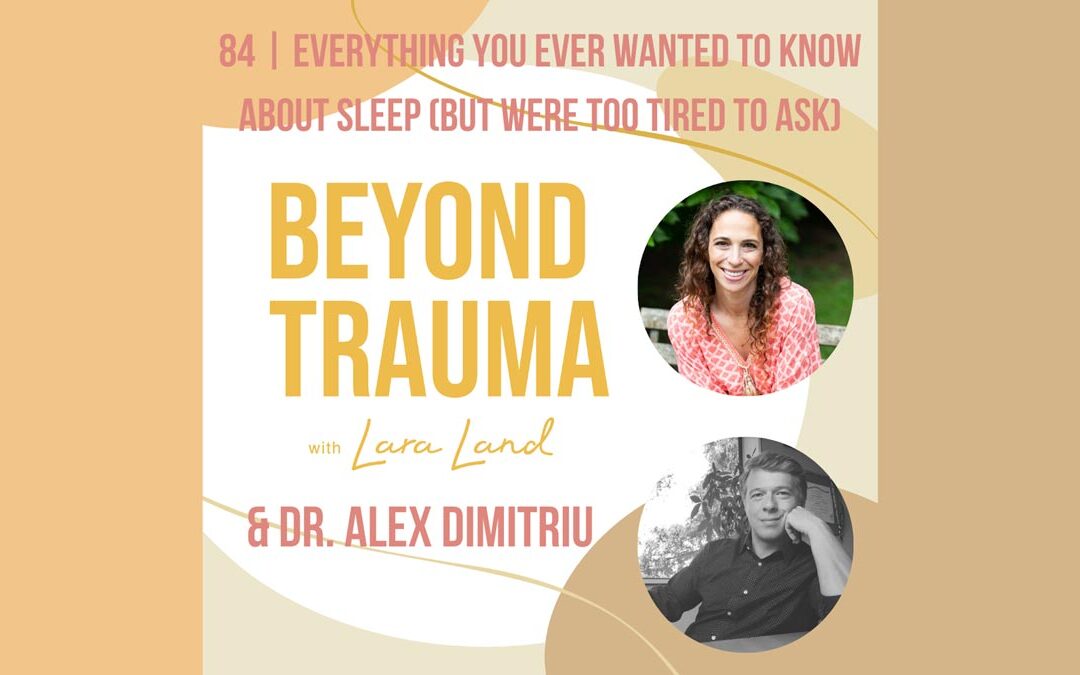
How to Actually Sleep: Breaking the Cycle of Stress and Sleeplessness

How to Actually Sleep: Breaking the Cycle of Stress and Sleeplessness

With insights from Dr. Alex Dimitriu, double board-certified in psychiatry and sleep medicine
If you’ve ever stared at the ceiling at 3 a.m. with your mind spinning, you’re not alone.

Sleep doesn’t come easy for many of us—especially those living with anxiety, trauma, or just the relentless pace of modern life. In fact, sleep is often the first thing to go when our nervous system is overwhelmed.

On a recent episode of Beyond Trauma, I sat down with Dr. Alex Dimitriu to unpack the complex, bidirectional relationship between sleep and stress. Together, we explored how poor sleep can increase anxiety—and how anxiety, in turn, sabotages rest. But here’s the good news: healing is possible, and better sleep is a cornerstone.

Whether you struggle with insomnia, wake up too early, or want to reclaim your evenings, this post will walk you through everything Dr. Alex and I discussed—along with my personal, proven tips for getting your best sleep yet.

🌞 The Morning Matters More Than You Think

One of the most surprising takeaways from my conversation with Dr. Alex? Your wake-up time is even more important than your bedtime. “Sleep pressure” builds throughout the day—and it starts the moment you get up.

Here’s what I recommend: get outside first thing in the morning. Just five minutes of natural sunlight tells your brain that it’s time to be alert—and sets your internal clock for better sleep later.

Avoid the snooze button, even if it’s tempting. Then, take a moment to set your intentions for the day. I use My Bliss Book—it’s how I stay grounded in what matters, which reduces stress and helps my mind wind down more easily at night.

☕ Coffee, Cortisol, and the Afternoon Slump

When it comes to coffee, timing is everything. Dr. Alex advises no caffeine after noon—and 11 a.m. if you tend to go to bed early. That post-lunch latte might seem harmless, but caffeine can stay in your system for 6–8 hours, disrupting your ability to fall and stay asleep.

Movement is also crucial. “Sleep is earned,” Dr. Alex told me, and that means building sleep pressure throughout your day. Whether it’s a walk, dance break, or yoga session, getting at least 30 minutes of activity helps your body crave rest by evening.

🌙 The Power of a Gentle Wind-Down

Too many of us try to go from 100 to 0—scrolling until our eyes blur, then wondering why we can’t fall asleep. But sleep doesn’t work that way.

Dr. Alex recommends creating a “slow-down runway” for your brain. I call it evening discipline—and here’s what mine looks like:

  • Stop eating two hours before bed. Instead, curb cravings with a mug of MoonBrew hot cocoa, a magnesium-based drink designed to naturally relax the nervous system. (Use code LaraLand30 for 30% off your first order!)
  • Dim the lights and ditch screens at least one hour before sleep. Blue light delays melatonin release.
  • Avoid heavy emotional conversations at night. Your mind needs calm, not conflict.

This kind of gentle ritual tells your body: “It’s safe now. You can rest.”

🛌 Create a Sleep Sanctuary

Your bedroom should feel like a spa, not a stress zone. Dr. Alex emphasized that coolness and darkness are among the most important environmental factors for quality sleep. Studies back this up.

After years of trying different bedding, I finally found the sheets that help me sleep deeply: Cozy Earth. Their bamboo fabric keeps me cool all night, and honestly, they feel like sleeping on a cloud. Use code LaraLand for 40% off their sheets and pajamas. You will not regret it.

🧠 Sleep, Trauma, and the Nervous System

We also dove deep into how trauma and PTSD affect sleep. Dr. Alex calls it “battlefield sleep”—where the nervous system is still on alert, even in rest. That’s why trauma survivors may experience vivid nightmares, frequent wake-ups, or difficulty falling asleep. Here’s what science says.

Here’s what helps:

  • Meditation: A regular practice helps train the body to feel safe and grounded. Research supports it.
  • Visualization: Mentally walking through a calming scene or memory can help transition from alertness to rest.
  • Sleep hygiene: Having the same wind-down each night builds trust and consistency in the body.

If you’re still struggling, Dr. Alex says it’s worth discussing medication with a professional. For treatment-resistant depression or trauma, ketamine therapy may be a powerful option—it’s fast-acting and has shown promise in restoring sleep in some patients.

🗺 Final Thoughts: Rest is Not a Luxury

Too many people think of sleep as optional. But in reality, your mental clarity, mood, decision-making, and healing capacity all depend on how well you sleep.

Here’s the truth: when you prioritize rest, you’re not being indulgent. You’re rebuilding your nervous system. And the effects ripple out into every area of your life.

Lara’s Essential Sleep Routine (Summarized)

Morning:

  • Wake at the same time daily (no snooze!).
  • Stand outside for 5 minutes of sunlight.
  • Set intentions with My Bliss Book.

Afternoon:

  • Move for 30+ minutes.
  • No caffeine after 12 p.m. (11 a.m. if you’re an early sleeper).

Evening:

  • No food two hours before bed.
  • Drink MoonBrew with code LaraLand30.
  • Dim lights, turn off screens one hour before sleep.
  • Avoid stress or conflict before bed.

Bedtime:

  • Make your bed a sanctuary.
  • Use Cozy Earth sheets with code LaraLand for 40% off.
  • Keep it cool and dark.
  • Use meditation or visualization to transition.

If this post helped you, share it with someone who needs to sleep better—and subscribe to the Beyond Trauma podcast for more expert insights.

Sweet dreams,
Lara 💜

Write something…

The Science of Kindness and Health

The Science of Kindness and Health

Harding’s research highlights several key areas where kindness and social connection measurably improve health outcomes:

  • Lower risk of heart disease: Supportive relationships have been linked to reduced blood pressure and inflammation.
  • Improved immune response: Acts of kindness and emotional warmth can actually boost immune function.
  • Decreased chronic stress: Kindness mitigates the stress response, reducing cortisol levels and protecting against burnout and anxiety.
  • Better outcomes in chronic illness: Patients with strong social bonds fare better with conditions like diabetes, cancer, and depression.

These findings are echoed in peer-reviewed studies on the social determinants of health, now recognized as central to public health frameworks worldwide. Read more in this National Institutes of Health overview.

🌍 Kindness Is Contagious—and Powerful

Harding’s work reminds us that healing doesn’t happen in a vacuum. Every interaction—with healthcare providers, loved ones, or strangers—has the potential to either harm or heal.

In healthcare settings, she advocates for policies that prioritize compassionate care, noting that patients treated with empathy have better adherence to treatment, fewer complications, and greater trust in medical institutions. And outside the clinic? Simple, everyday acts—smiling, listening, offering help—can ripple outward in powerful ways.

Want to integrate more kindness into your life? Explore this Greater Good Science Center resource on practical ways to live more compassionately.

🎙️ Listen to Dr. Kelli Harding on Beyond Trauma

We’re honored to welcome Dr. Harding to the Beyond Trauma podcast, where she shares:

  • Her personal journey into this groundbreaking work
  • The hidden ways trauma and isolation affect the body
  • How kindness can be cultivated—even in a divided world
  • What she believes is the future of healthcare

👉 Listen to the full episode here and discover why kindness isn’t just a virtue—it’s a prescription for better health

Breathe to Heal: How Max Strom Uses Breathwork and Group Support to Release Trauma

Breathe to Heal: How Max Strom Uses Breathwork and Group Support to Release Trauma

In today’s high-stress world, many of us are searching for ways to release the emotional pain we carry—often silently.

For author, teacher, and transformational breathwork pioneer Max Strom, the key to deep healing lies not in talking alone, but in breathing. Through his signature Inner Axis system, Strom has helped thousands of people reduce anxiety, address trauma, and reconnect with their emotional lives—without needing to relive every painful memory.

🌬️ Why Breathwork Is So Powerful for Trauma Healing

Trauma isn’t just held in the mind—it’s stored in the body. That’s why traditional talk therapy, while important, can sometimes fall short in providing full emotional relief. Breathwork, especially the kind taught by Max Strom, offers a direct somatic route to healing.

“You can’t think your way out of grief or trauma. But you can breathe your way through it,” Strom often says in his workshops.

His breathwork for trauma approach integrates conscious breathing patterns with gentle movement, mindfulness, and emotional awareness. Unlike intense or fast-paced breathing modalities, Strom’s technique is accessible and calming—designed to be practiced by people of all ages and physical abilities.

Learn more about breathwork and its benefits for trauma here.

🔄 The Power of Group Support: Witnessed Healing

In addition to his breathwork teachings, Max Strom has introduced the practice of group work into many of his events. Rooted in group process work and authentic relating, group work invites participants to sit together in a safe, nonjudgmental space and share from the heart.

Being witnessed in our vulnerability, without advice or interruption, can be a deeply healing experience. As Strom explains:

“Sometimes what we need most isn’t someone to fix us, but someone to truly see us.”

Group work is especially beneficial for those who have experienced relational trauma, shame, or long-standing disconnection. It offers an antidote to isolation and a return to communal support.

Explore the benefits of group therapy and circling for trauma.

📚 Max Strom’s Books and Global Teaching

Max Strom is the author of two acclaimed books on healing and emotional well-being:

  • A Life Worth Breathing
  • There Is No App for Happiness

Both explore how the modern world’s emphasis on productivity and digital distraction disconnects us from our deeper emotional needs—and how practices like conscious breathing can bring us back home to ourselves.

Through his Inner Axis system, he has taught in more than 30 countries, offering trainings, retreats, and keynotes that blend emotional healing, mindfulness, and breath-based movement.

Visit Max Strom’s official website to find upcoming workshops and online courses.

🎧 Max Strom on the Beyond Trauma Podcast

Max Strom recently joined host Lara Land on the Beyond Trauma podcast for an insightful, heartfelt conversation about how breathwork can unlock suppressed grief, why our digital lives are contributing to emotional illness, and how we can all learn to heal—even without reliving trauma.

You’ll hear Max talk about:

  • The role of breath in processing unresolved emotions
  • His own journey from grief to purpose
  • Practical tools for self-regulation and nervous system repair
  • Why we need less technology and more connection

▶️ Listen now to Max Strom on Beyond Trauma or wherever you get your podcasts.

💡 Final Thoughts: You Don’t Have to Carry It Alone

Trauma can be heavy. But with the right tools, support, and breath, healing is not only possible—it’s inevitable. Max Strom offers a grounded, gentle path back to emotional clarity and inner peace, no matter your story or starting point.

Whether you’re a seasoned yogi, a therapy veteran, or just beginning your healing journey, breathwork and conscious connection may be the medicine you’ve been looking for.